Group Sequence Policy Optimization (GSPO)#
Last updated: Oct 30, 2025
Author: Bruce Li
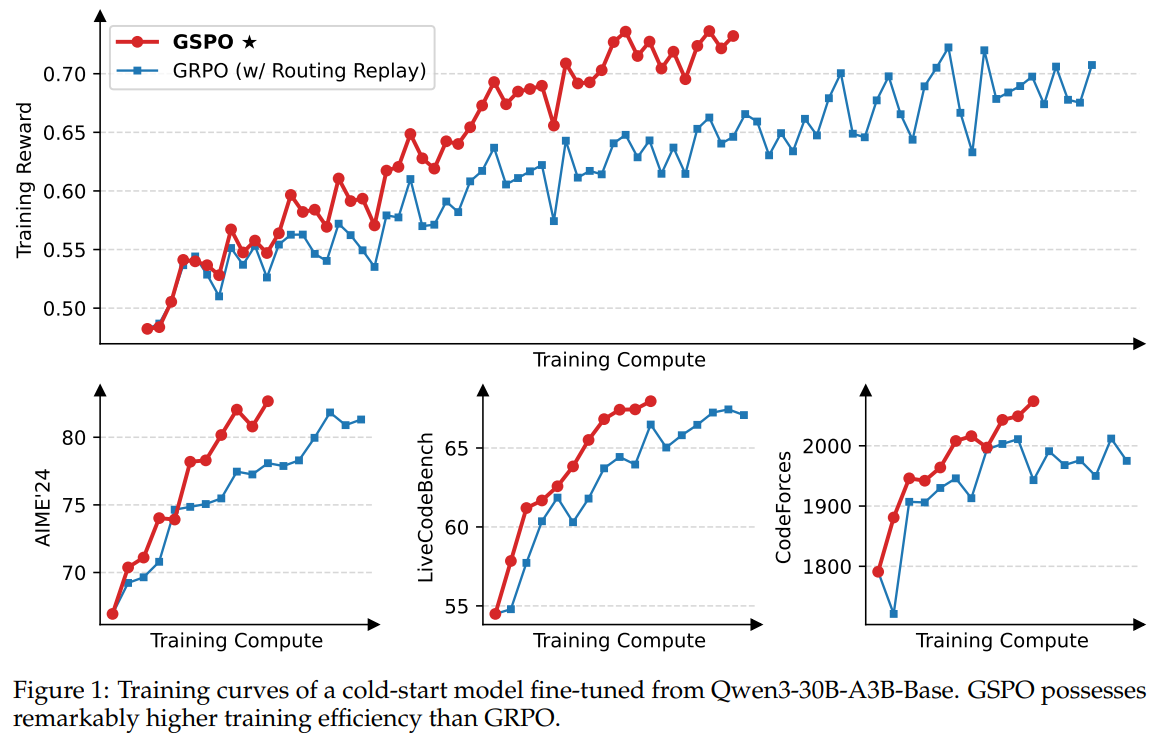
Group Sequence Policy Optimization (GSPO), introduced by Zheng et al. (2025) in the context of training Qwen3 models, is a reinforcement learning algorithm that extends PPO by computing importance sampling ratios at the sequence level rather than the token level. Unlike standard PPO which computes a separate probability ratio for each token, GSPO calculates a single ratio per sequence as the geometric mean of per-token probability ratios, then applies this uniform ratio to all tokens within that sequence.
This sequence-level approach provides several key advantages: improved training stability especially for Mixture-of-Experts (MoE) models, reduced variance in policy updates when optimizing sequence-level rewards, and potential simplification of RL infrastructure design. GSPO has been successfully deployed in large-scale RL training for the Qwen3 model family.
Algorithm Overview#
The key distinction between GSPO and traditional PPO lies in the computation of importance sampling ratios:
Standard PPO (token-level):
Computes per-token ratio: \(r_{i,t}(\theta) = \frac{\pi_\theta(o_{i,t} \mid q, o_{i,<t})}{\pi_{\theta_{\text{old}}}(o_{i,t} \mid q, o_{i,<t})}\)
Each token has its own importance weight
Advantages are computed and applied per token
GSPO (sequence-level):
Computes sequence-level geometric mean ratio: \(r_i(\theta) = \exp\left(\frac{1}{|o_i|}\sum_{t=1}^{|o_i|} \log\frac{\pi_\theta(o_{i,t} \mid q, o_{i,<t})}{\pi_{\theta_{\text{old}}}(o_{i,t} \mid q, o_{i,<t})}\right)\)
All tokens in a sequence share the same importance weight
Advantages are aggregated per sequence: Each sequence contributes its total advantage (sum of per-token advantages) to the objective, ensuring gradient magnitude is independent of sequence length
Algorithm Core Parameters#
GSPO shares most parameters with GRPO, with one key addition:
actor.importance_sampling_level: Set to"sequence"to enable GSPO (default"token"for standard PPO/GRPO)
Example Usage#
We recommend reusing PPO-like training scripts, and changing parameters within the configuration file (e.g., gsm8k_rl.py + gsm8k_gspo.yaml).
Backend |
CMD |
|---|---|
local |
|
ray |
|
slurm |
|
To enable GSPO, set importance_sampling_level: sequence in the actor configuration:
actor:
  importance_sampling_level: sequence  # 'token' for standard PPO, 'sequence' for GSPO
  # ... other configurations
Adding GSPO to Other Algorithms#
GSPO can be easily applied to any PPO-based algorithm by adding the importance_sampling_level parameter. For example, to use GSPO with GRPO:
python3 -m areal.launcher.local examples/math/gsm8k_rl.py --config examples/math/gsm8k_grpo.yaml +actor.importance_sampling_level=sequence
Note: The plus sign (+) is required when the key importance_sampling_level is not in the YAML file.
When to Use GSPO#
GSPO is particularly beneficial in the following scenarios:
Sequence-level rewards: When rewards are assigned based on entire sequences (e.g., task success/failure) rather than individual tokens
MoE model training: GSPO has been shown to stabilize Mixture-of-Experts reinforcement learning training
High variance in token-level gradients: The sequence-level geometric mean helps reduce variance
Long-horizon tasks: When token-level credit assignment is difficult or unreliable
Baselines#
We still lack baselines, welcome to contribute!